Breast Cancer Awareness Month
"Include Yourself Among the People You Care For": A Patient Perspective on Breast Cancer Screening
A conversation with Ms Tsirogianni, President of the Cancer Patients and Friends Association of Arta "Epistithioi Filoi", on access to breast cancer screening, patient trust in Artificial Intelligence, and the importance of designing health technologies around people's needs.
1 October 2026
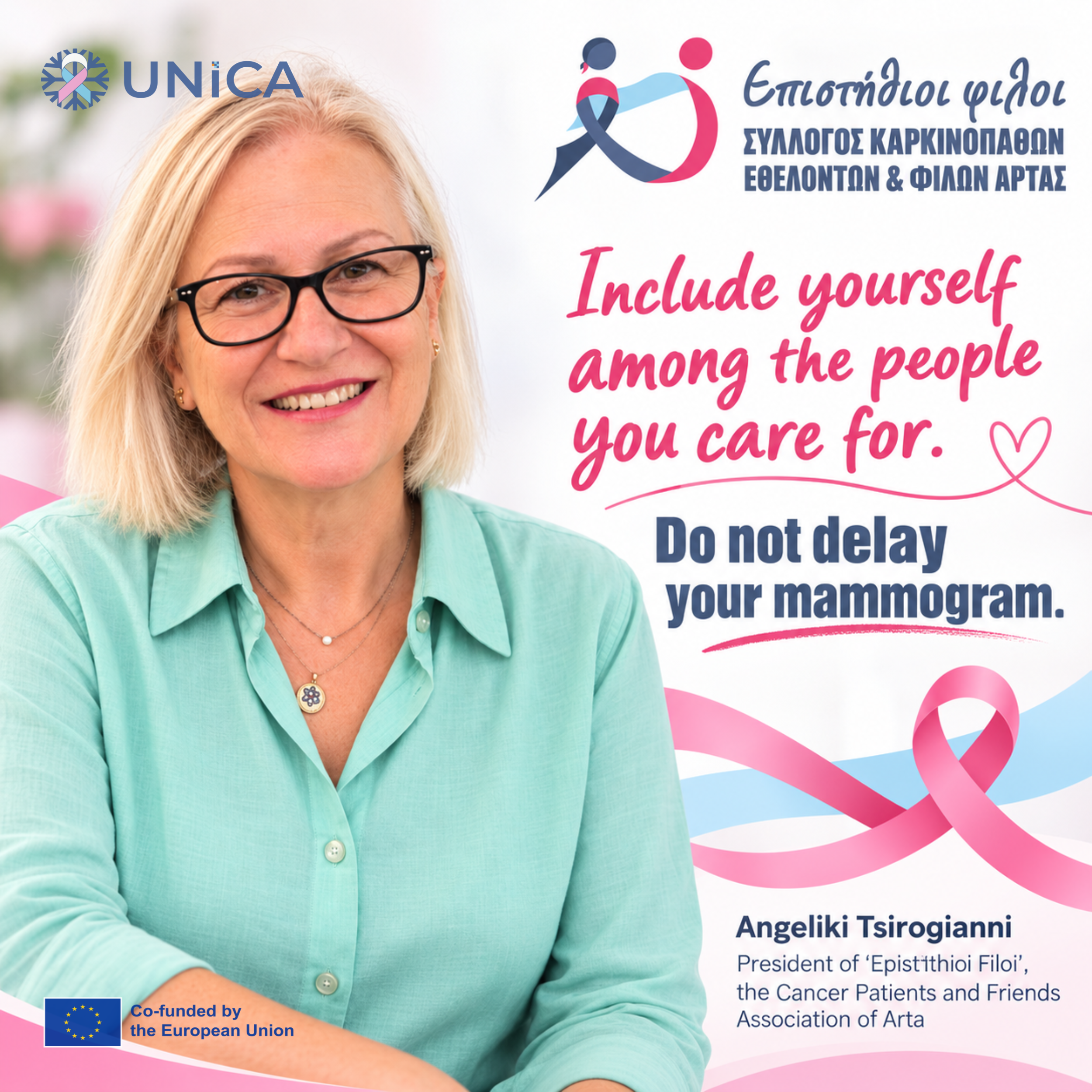
As Breast Cancer Awareness Month begins, UNICA speaks with Ms Tsirogianni, President of the Cancer Patients and Friends Association of Arta "Epistithioi Filoi", about some of the barriers that continue to affect participation in breast cancer screening and the importance of making prevention accessible to women in regional and remote communities.
Drawing on her experience with patients and the local community in Arta, Greece, she also reflects on what patients need in order to trust Artificial Intelligence in healthcare, why patients should be involved in the development of new technologies, and how screening can become a more natural part of self-care.
"Information alone is not enough. It must be accompanied by real access."
Ms Tsirogianni, as President of the Cancer Patients and Friends Association of Arta "Epistithioi Filoi", and through your contact with patients and the local community, what do you consider to be the main barriers to participation in breast cancer screening?
In a region like Arta, I would say that the barriers are psychological and social, as well as practical.
On the one hand, there is fear of what the examination might reveal, putting it off, lack of time, but also the mistaken belief that "if I am not in pain and have no symptoms, I do not need to be screened." Yet screening takes place precisely when we feel well, so that a potential problem can be detected as early as possible.
I also believe there is a deeper cultural issue around prevention and self-care. Very often, we approach our health reactively: we take action when a symptom or problem appears, instead of making preventive screening a regular part of looking after our health.
At the same time, the fear and stigma surrounding the word "cancer" have not completely disappeared. Even today, we still come across euphemisms such as "that terrible disease" or "the dreaded disease", as if we still find it difficult even to say the word itself. And this matters: when we find it difficult to talk openly about a disease, it also becomes harder to talk about prevention, screening and early diagnosis. I hope this attitude will continue to fade over time.
On the other hand, there is also the reality of living in a regional area. Living in the centre of a town is very different from living in a remote or mountainous village. For an older woman who does not drive or depends on someone else for transportation, access can become a significant barrier.
That is why information alone is not enough. It must be accompanied by real access. Screening should be made as simple and accessible as possible, so that the process itself does not become yet another obstacle.
What do we currently know about participation in screening in Greece? Are there groups of women who seem to participate less, and what do you believe is needed in order to reach them?
Available data show that in Greece there have been, and continue to be, significant inequalities in participation, depending on factors such as educational and socioeconomic background.
These inequalities are quite striking. According to European data, in 2019 only around 53% of women with lower education levels in Greece reported having had a mammogram within the previous two years, compared with 80% of women with higher education levels.1 This shows that making screening available does not necessarily mean that every woman has the same opportunity or ability to participate.
At the same time, there has been very encouraging progress. The "Fofi Gennimata" programme brought about an important change by providing organised and free screening and making access easier for a large number of women. The expansion of organised prevention can also be seen in the numbers: the number of mammograms performed through the national prevention programme increased from 69,156 in 2022 to 400,517 in 2025.2
53% vs 80%
Women with lower vs higher education levels in Greece reporting a mammogram within the previous two years in 2019
However, for us, the important question remains: which women are still being left behind?
We need to understand whether older women, women with lower levels of digital literacy, or those living in remote areas face greater difficulties.
Equal access does not simply mean that an examination is free of charge. It means that a woman, even in the most remote village of Arta, can actually access and undergo that examination.
And this is where I believe local organisations and patient associations have an important role to play, because they can bring information and support closer to the community itself.
As Artificial Intelligence is increasingly being used in medical image analysis, what do you consider to be the key conditions for patients to trust these technologies?
Trust in Artificial Intelligence should be neither blind nor driven by fear. It should be based on specific conditions.
Naturally, the technology must be reliable and thoroughly validated, but for the patient, human oversight, transparency and data protection are equally important.
Artificial Intelligence should function as a support tool rather than as a substitute for the doctor. It can act as a "second pair of eyes", but the final judgement, responsibility and communication with the patient must remain with the healthcare professional.
Transparency is also essential. Patients should know when AI is being used, what role it plays and who ultimately makes the decision.
And, of course, there is the critical issue of data privacy. Patients may reasonably worry that their medical data could one day be used for other purposes or shared with insurance companies, banks, employers or other organisations. A general assurance that "the data are secure" is not enough. It must be clear who has access, for what purpose, whether the data are anonymised or pseudonymised, and who ensures that they are not misused.
For me, trust is not only about the algorithm. It concerns the entire system around it: transparency, data protection and keeping the doctor at the centre of care.
"We want technology to be an ally of the doctor, not a substitute for the human relationship."
As new tools are being developed, such as Artificial Intelligence systems for medical image analysis and risk assessment, what would you ask of researchers so that these technologies are genuinely useful and accessible to patients?
I would tell researchers that a new technology has value only if it solves a real problem for the patient.
If, for example, Artificial Intelligence can help a doctor detect a suspicious finding earlier or better assess who requires closer monitoring, that is extremely valuable.
However, the tool must be easy to use, integrate smoothly into clinical practice and not create new barriers for the patient.
I also believe it is important not to design exclusively for digitally confident citizens living in major urban centres. Technology must also benefit people living in regional areas, who may be older or may not have easy access to specialised services.
And one more thing: patients and patient associations should be involved from the very beginning in the co-design of these tools. They can explain where patients face difficulties, what they do not understand, what they fear and what would genuinely help them.
Simply put, technology should adapt to people's needs rather than expecting people to adapt to technology.
With October being Breast Cancer Awareness Month, what is the main message you would like to send to women regarding regular screening?
I would like us to shift the narrative slightly.
We should not associate mammography only with fear of the disease, but also with self-care.
Screening does not prevent breast cancer from developing. It does, however, give us the opportunity to detect a potential problem earlier and take timely action.
The message I would like to send from Arta to every woman is very simple:
"Include yourself among the people you care for.
Do not delay your mammogram."
Ms Tsirogianni
President, Cancer Patients and Friends Association of Arta "Epistithioi Filoi"
Sources
1. OECD/European Commission (2025), EU Country Cancer Profile: Greece 2025, OECD Publishing, Paris.
2. Hellenic Republic - Greek Government (2026), Review of Government Work for 2025 - Unified Government Policy Plan 2026, January 2026, National Prevention Programme "PROLAMVANO".